Acquisition
2002

Doug Aitken
American, born 1968
Thaw, 2001 Color film, sound, transferred to three-channel digital video (projections on three attached screens); 4:10 min. loop


The Artist

Born in Redondo Beach, California, in 1968, Doug Aitken studied at Marymount College, Palos Verdes, in 1986–87 and at the Art Center College of Design, Pasadena, in 1987–91. He began his career as a prolific director of music videos, for artists including Fatboy Slim, Iggy Pop, Barenaked Ladies, and µ-ziq. Aitken's work has been the subject of numerous solo and group exhibitions worldwide at many institutions including The Museum of Modern Art, New York; the Centre Pompidou, Paris; the Museum of Contemporary Art, Los Angeles; the Serpentine, London; and the Vienna Secession. At the 48th Venice Biennale in 1999, the jury awarded Aitken the Premio Internazionale for his installation Electric Earth, a mesmerising and eerie evocation of dislocation in the modern urban landscape.

The Acquisition

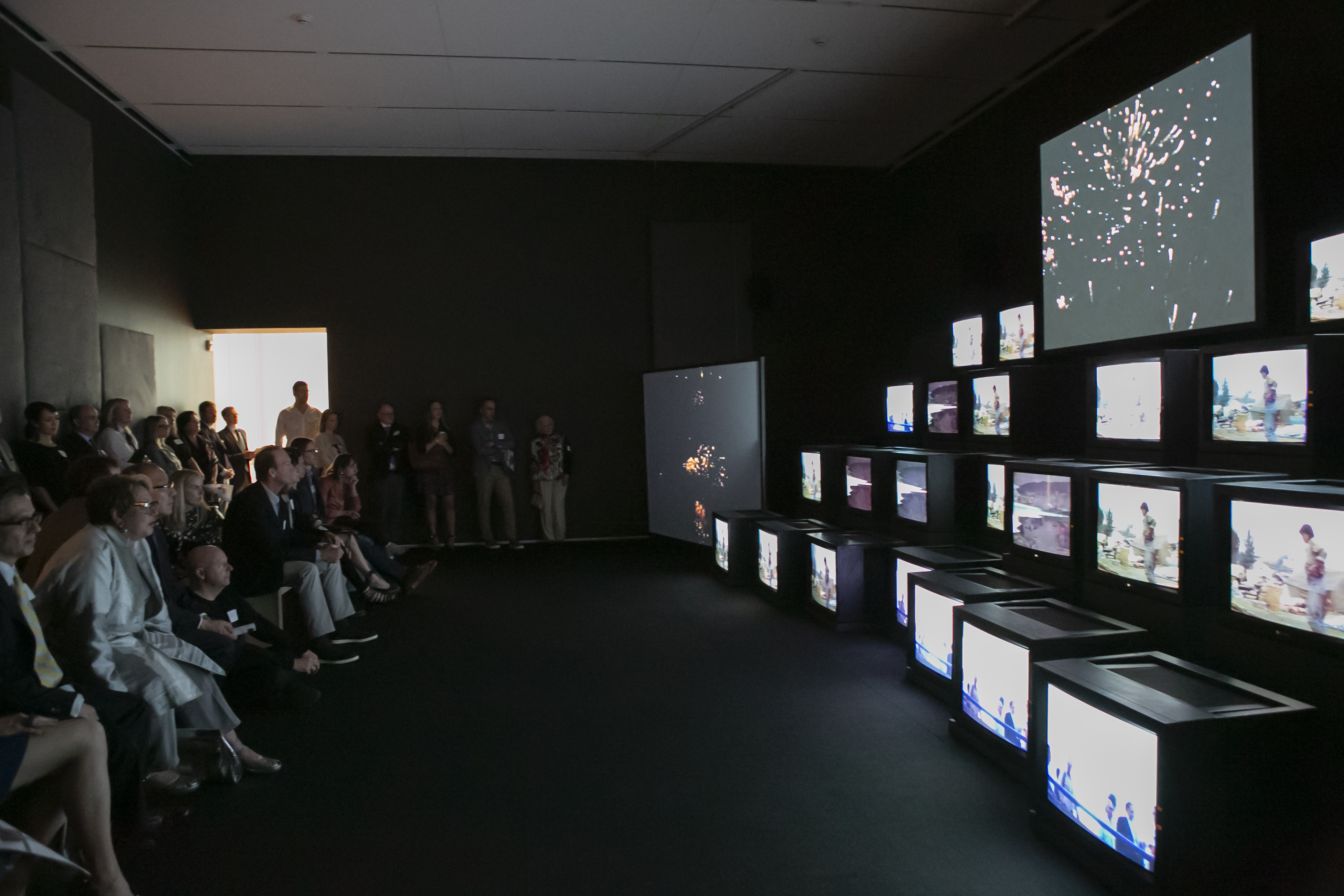
Thaw, a three-channel digital video projection, is part of a recent series of works entitled “New Ocean.”  The location is a glacial mass in Alaska.  This syncopated, split-screen portrait of a place turns the natural processes of warming ice into an almost theoretical observation on the more abstracted notions of flow and change.  In Aitken’s vocabulary, thaw—a word describing a physical change—becomes as much a description of a set of sounds as it is of images.  Significantly, the artist combines natural, recorded sounds and electronically generated manipulations into new, almost symphonic compositions. Describing his practice, the artist uses language apt for a discussion of this work: “I have a restlessness with the way a photograph captures time…The static quality of the ‘frozen’ image or decisive ‘moment’ is not enough…I would like to smash a photograph, open it and see what’s inside.  Maybe then this so-called ‘frozen’ time could expand and contract.  In that sense, images are like liquids…” In this way, Thaw stages a metaphoric, even philosophical, commentary on an art historical transition from still (frozen) to filmic (liquid) images.